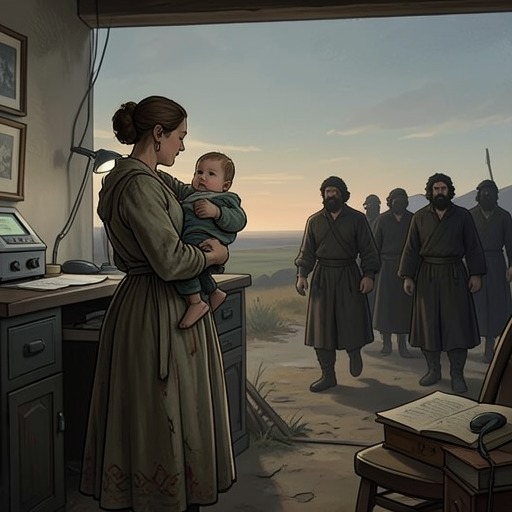
Miss Shirley
The Drover's WifeMiss Shirley, the minister’s wife, is both an early caregiver to Molly Johnson and a later advocate of separating Molly’s children from her. Her importance lies in that reversal: the woman who once housed and clothed a child eventually helps turn racial classification into official authority over that child’s family. The novel places her charitable role, moral influence, and paternalistic intervention in uneasy succession, exposing how care can coexist with a demand to control.
Early care and its limits
When Molly was young, her father left her with Miss Shirley during his droving journeys. Miss Shirley fed her and dressed her so that she looked like a doll; in Molly’s account, these were concrete acts of proper care. Molly’s father, otherwise taking her along as a helping hand, left her behind only on those occasions. He tried to soften the separation by urging her to get cakes and sweets from Miss Shirley, then to go straight home and help him. That remembered kindness also remained linked to being left behind.
Miss Shirley’s household was connected to church life and to a particular model of feminine respectability. She was married to Father McGuinness, who was ten years older, and described herself as having a large flock despite being barren. She also involved herself in young mothers’ affairs. Her position gave her access to families and influence over the terms in which women’s care and conduct were discussed; the evidence presents that influence as intrusive as well as benevolent.
Molly’s attachment to Miss Shirley did not erase the affection she saw other children receive. At about ten, while staying with the couple, Molly watched mothers touch their children gently and show pride and love. She sometimes took Miss Shirley’s arm and placed it around her own shoulder, seeking a gesture of care she had observed elsewhere. This small action makes the difference between being fed and clothed and being openly cherished visible without suggesting that Miss Shirley understood or answered Molly’s longing.
When Molly began menstruating, her father again took her to stay with Miss Shirley for a week. Miss Shirley instructed her in what she considered necessary for marriage and being a good wife, including how she should serve a husband. Molly asked what the husband was expected to do to make the relationship pleasant for her; Miss Shirley did not answer. The silence marks the limits of the instruction: Molly’s question about reciprocity receives no guidance, while duty is presented as the practical preparation for womanhood.
From caregiver to racial classifier
Years later, Miss Shirley’s account of Molly’s ancestry emerges in a setting where official authority can act on what she says. She tells Judge Eisenmangher that she had heard stories from Molly’s father but had not previously shared them because she could not obtain a sober confession from him. Rum, she says, had been the only means of eliciting the truth. She nevertheless believes the stories and says she had long sensed that Molly was more than she appeared to be.
Miss Shirley recalls that Black Mary was about six years younger than she was, and that Black Mary was sixteen when first seen by the Edwards family. She describes the Edwards as Black Mary’s first encounter with white people and says there is a story to be told about it. In speaking to the judge, Miss Shirley frames the relationship between Molly’s parents as a troubling mixture and treats Molly’s mixed heritage as a source of confusion for children. Her recollection thus supplies information about Molly’s family while also revealing the racial judgment through which Miss Shirley interprets it.
That judgment becomes an argument for intervention. Miss Shirley labels Molly’s children octaroons and tells Judge Eisenmangher that they urgently need help. She also invokes the possibility that Molly is sheltering Yadaka, a wanted Aboriginal man, and asks what can be done. The language of protection makes the proposal sound benevolent, but its practical consequence is the removal of children from their mother. The judge signs the authorization and gives Miss Shirley the letter, converting her racial assessment into a document with coercive force.
The order and Molly’s response
Miss Shirley’s earlier presence in Molly’s childhood changes the meaning of this intervention. Molly has already learned that, as a child, Miss Shirley discussed sending her away because of her suspected mixed heritage. The plan had been framed as rescue from her father and as a means of cleansing her of what was described as inherited filth; Molly had been told she could be classified in a way that would get her sent away. The later order therefore revives an old threat rather than introducing a wholly new danger.
Molly learns of the new classification when Danny tells her that Miss Shirley called the children octaroons before the judge. Molly recognizes the word and connects it with the earlier conversation she overheard while staying with Miss Shirley. The connection makes the threat legible to her: this is not simply a dispute about a document, but an extension of a racialized plan to decide where children of mixed descent belong and who may raise them.
Molly confronts the couple at their home. Miss Shirley and Father McGuinness are left bound and gagged in their nightclothes after resistance, with furniture scattered and a glass vase broken. Molly holds the authorization before Miss Shirley and condemns her for presuming to know what is best for Molly’s children. She takes blankets and food, then throws the document into the fire. The paper’s destruction directly prevents the signed order from remaining in force as the instrument of removal; Molly leaves the couple alive and departs with supplies.
The scene reverses the power relation established in childhood. Molly, once dependent on Miss Shirley for food and clothing, now controls the document and determines the immediate outcome. Miss Shirley’s fear and relief at being spared coexist, while Father McGuinness appears distressed. The confrontation is not presented as reconciliation: the earlier care remains part of their history, but it cannot undo the attempt to separate Molly from her children.
Public influence and narrative significance
Miss Shirley’s role reaches beyond the private history between the two women. As the minister’s wife, she can present herself before a judge as a concerned witness and can describe the children through a racial category that makes their removal appear necessary. The contrast between her earlier household care and her later appeal for state intervention shows that personal kindness does not prevent someone from participating in discriminatory systems. Her influence is neither equivalent to the judge’s legal power nor merely private opinion: she supplies the claim, and the judge’s signature gives that claim official effect.
The novel later places her testimony within the case against Molly. At Molly’s trial, the all-male jury hears Miss Shirley’s declaration about Molly’s mixed heritage, while the Crown argues that Molly’s actions arose from inherited hatred and from what Yadaka had told her about her ancestry and her mother’s suffering. In this public account, the family history Miss Shirley helped disclose is recast as evidence against Molly. The same revelation that could have prompted understanding instead becomes part of a prosecution narrative that attributes Molly’s conduct to racial inheritance and influence.
Miss Shirley is therefore not simply a childhood benefactor or a single-minded antagonist. Her actions expose the gap between care as provision and care as respect for a mother’s agency and a family’s continuity. She feeds and clothes Molly, yet later supports a process that would take Molly’s children; she speaks in the language of their safety, yet relies on racial classification to define them as removable. The child who once placed Miss Shirley’s arm around her shoulder ultimately rejects her authority over the next generation.